 Last week I began the epic tale of my experience as a judge for the 2017 Aui Pastry Cup. I have no doubt that since then, you’ve been waiting by your inbox, barely daring to breathe, in frantic anticipation of what happened next. Worry no more, because this week brings our dramatic conclusion!
When last we left off, three of the original eleven Chefs competing were about to move on to the final. At stake was $5000, $500 in AUI (Albert Uster Imports) product, the AUI Pastry Cup itself (which was legit. I got to touch it.), a feature in So Good… Magazine, and that indescribable feeling of accomplishing a goal and seeing all of your hard work and sacrifice pay off.
round 3
This was it, the make it or break it round. Of all three rounds, the final one proved to be the most difficult and stressful for the Chefs. Speaking of, the finalists were:
Kevin Clemenceau Chocolatier & Pastry Sous Chef, Pitchoun Bakery Café
Ryan Westover Chocolatier & Baking/Pastry Chef Instructor, Bluprint Chocolatiers & Stratford University
Erin Reed Executive Pastry Chef, Park Hyatt & Blue Duck Tavern
Round three gave the chefs six hours to make two identical entremets and two different recipes of 24 molded chocolates (as opposed to a chocolate candy that is hand dipped) for a total of 48 chocolate candies. They had two hours the evening of day one to do as much/any prep as they wanted. On the morning of day two they had an additional four hours to complete their work. Splitting the work time over two days and the nature of the products being made significantly increased the amount of multitasking the chefs would have to perform and would also increase the need for thorough organization.
what I was looking for in round 3


By this time in the competition, I had watched these three chefs work for several hours, and I had a pretty good idea of what I would continue to see from them, good and bad. The x factor is always how a chef (or anyone for that matter) reacts under pressure. Up until this point, the structure of the round was straightforward and manageable. In the final round, though, each of the chefs would make mistakes, so I was curious to see how they responded.

Round three required all of the finalists to temper and work with chocolate, which is a skill set that isn’t easy to develop and is glaringly obvious when someone hasn’t practiced (cleanliness can easily become an…issue). I was definitely interested in seeing how the competitors worked with chocolate.
As a competition continues, I’m watching to see if a chef who started with a bad habit corrects it, and conversely to see if a chef who started with a good habit begins to get slack or sloppy. It’s a great thing to watch a chef improve over time, because it shows a certain level of awareness and commitment to what they’re doing. If a competitor responds immediately to a judge’s critiques or even better, catches themself working poorly and takes the initiative to improve, it goes a long way in my book towards forgiving early mistakes.


The one thing I don’t want to see is a competitor that begins to slack over time, or one that starts poorly and doesn’t seem to have the will or desire to push through. The most important thing you can do once the clock starts is push hard and never, never, never give up. Rolling over and quitting shouldn’t even be in your realm of consciousness. No matter what happens, you keep working until the finish line, because you owe it to your friends and family who supported you, the competitors who would kill to be in your place, and yourself, to do so.
molded chocolates

Chef Ryan Westover. Banana rum ganache, feuillitine.

Chef Ryan Westover. Banana rum ganache, feuillitine.

Chef Ryan Westover. Mandarin ganache.

Chef Ryan Westover. Mandarin ganache.

Chef Erin Reed. Apple compote, copes corn ganache.

Chef Erin Reed. Apple compote, copes corn ganache.

Chef Erin Reed. Pistachio ganache, beet jam.

Chef Erin Reed. Pistachio ganache, beet jam.

Chef Kevin Clemenceau. “Polynesia” Mango passion fruit gelee, coconut praline.

Chef Kevin Clemenceau. “Polynesia” Mango passion fruit gelee, coconut praline.

Chef Kevin Clemenceau. “Two Raspberries” Raspberry reduction, raspberry white chocolate ganache.

Chef Kevin Clemenceau. “Two Raspberries” Raspberry reduction, raspberry white chocolate ganache.
There are a lot of elements to judge when it comes to chocolate bonbons. As always, taste is first and foremost in importance to me. I want a chocolate candy that has a good balance and depth of flavor, and uses and integrates the chocolate elements well. You’d be surprised how much the chocolate used as the shell of the candy will transform the overall flavor, for better or worse.
In terms of flavor I’m looking for something that isn’t overly complicated in profile. A bonbon is a quick, small, bite and you don’t have the real estate or ability to interact with the product like you do a plated dessert, so creating flavors that are easy to distinguish always works well. I always love the addition of crunchy texture in a bonbon, and of course all ganaches (the ubiquitous bonbon filling) should be creamy and smooth no matter how dense it is.
The quality of the tempered chocolate in making the bonbon shells is a damn close second in importance to me. Maybe I’m just getting old, but there’s something authentically artisan (a term that has been beaten within an inch of its life in recent years) about hand molding chocolates. As a pastry artisan, I like to see the tradition being upheld and honored with good work. From a practical standpoint, a well tempered shell is going to have the best melt point and mouth feel, as well as create the most attractive bonbon.
Speaking of good looks, there’s the chocolate bonbon’s appearance to consider. The sky’s the limit when it comes to colors and finishes for a molded candy, but that doesn’t mean go nuts. This is an area where basic color theory can do wonders, so I encourage all cooks and chefs out there to load up on a little of that knowledge.
entremet

Chef Ryan Westover. “70s Nouveau Entremet” Passion fruit mango jelly, Chocolate pistachio almond cookie, chocolate coconut mousse, pistachio mousse.

Chef Ryan Westover. “70s Nouveau Entremet” Passion fruit mango jelly, Chocolate pistachio almond cookie, chocolate coconut mousse, pistachio mousse.

Chef Erin Reed. Strawberry mousse, coconut mousse, strawberry gel, matcha white chocolate mousse, yuzu curd, strawberry meringue.

Chef Erin Reed. Strawberry mousse, coconut mousse, strawberry gel, matcha white chocolate mousse, yuzu curd, strawberry meringue.

Chef Kevin Clemenceau. Granny Smith gelee, ginger and lemongrass cremeux, almond streusel, granny smith almond cream, lemon vanilla bavarian.

Chef Kevin Clemenceau. Granny Smith gelee, ginger and lemongrass cremeux, almond streusel, granny smith almond cream, lemon vanilla bavarian.
Entremets are my pride and joy. I love the process of designing them and I love making them. It’s one of a few things I’ll be bold enough to say I think I do pretty damn well. To me they are a quintessential element to a comprehensive pastry competition. With all of that being said, I scrutinize the hell out of them (most of all my own).
Easily the most common mistake made with competition entremets is serving them at the incorrect temperature, nearly always too cold and/or frozen. Entremet need to be fully frozen in order to unmold and finish, so getting the timing right to give the cake enough thawing and tempering before service can be tricky.
There’s no universal standard for what temperature is perfect, but I want a chilled product that has warmed enough to open the flavors and sweetness of the various elements but not be so warm that textures suffer or that flavor gets heavy or overly sweet.
The second most common mistake (in my mind) is bad glaze. The vast majority of entremets are finished with a coat of shiny glaze – as seen on countless instagram accounts. The shine and stability of the glaze are created through the use of sugar and gelatin (or a similar stabilizer). Too much of either of those and the taste and the texture of the glaze can be ruined. Sadly a lot of chefs think only of the look of the glaze when applied to the cake, and forget it’s an edible element of the entremet first.
If only the right temperature and a tasty glaze were all that was needed for a top notch entremet. We haven’t even gotten into the thing yet. As I like to say “it’s what’s on the inside that counts.” An entremet should have a balanced variety of components, both in flavor and texture. Too few components will lack contrast and doesn’t show a lot of work ethic, and too many components can become muddled. I want the cake itself to cut cleanly and easily, and for the cake to maintain its form while I’m eating it, which shows the right technique in layering and building.
The finish of the entremet – it’s décor and how it is glazed or sprayed – should be clean, modern, sharp, elegant and reflect the nature of its flavor profile. Like the bonbons, proper use of color can make or break even the best work.
and the winner is…
All three finalists completed their work on time, pushing through bumps in the road with focus and professionalism. You could see the unique creativity and personality of each chef through their product, which was really cool to watch.
In third place was Chef Erin Reed! Erin was one cool customer. Nothing seemed to phase her during the competition. I thought Erin showed a lot of technique and touch in her product. Her pre dessert was one of my favorites, and I thought all of her work had a pleasing esthetic.
In second place was Chef Ryan Westover! Like Erin, Ryan was a smooth operator. Between the two of them the building could have been burning down around them and you wouldn’t have known it from the looks on their face. I was really intrigued with Ryan’s pre dessert as well. He really took a chance with his flavors and components and it was the most appropriately creative dish I saw throughout the whole competition.
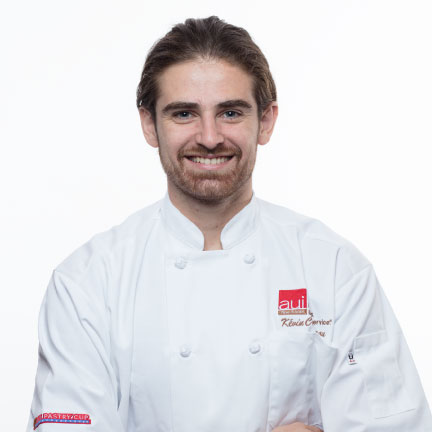
Photo courtesy of Albert Uster Imports
In first place was Chef Kevin Clemenceau! Kevin worked hard from the very first minute to the very last. He was the most organized of all of the competitors throughout each round, and you could tell that although his pace seemed at times on the verge of frantic, he had a set game plan and he was sticking to it. Kevin’s flavors and products weren’t the most inventive, but they were clean and defined and well executed. All of his finishes were sharp and overall it was Kevin who had done the most preparation for the competition. Beyond that, Kevin had a great attitude. He took critique very well, and it was clear he simply wanted to continue to improve. Congratulations Kevin, it was a well-deserved win!
I mentioned it last week and I want to say it again, I think all of the competitors should be very proud of themselves. Just to compete takes a level of commitment and sacrifice that you can’t understand unless you’ve been there. To go that extra step and put yourself and your work out there to be judged and seen by so many takes courage. Regardless of any outcomes, putting in the time and effort, showing up and doing your absolute best no matter what is a win in my book.
Cheers – Chef Scott


Leave a Reply